Getting between Incheon Airport and Seoul
AREX, airport buses and taxis — both directions, terminal by terminal, from Incheon Airport into Seoul and back out to your flight.
Language

There are three ways between Incheon International Airport and Seoul: the airport railroad (AREX), an airport bus, and a taxi. This page does not cover only one direction — airport → Seoul and Seoul → airport are laid out the same way.
Start by settling your direction and your terminal (T1 or T2), then pick the mode that fits where you are staying and how much luggage you have.
Start here
Airport → Seoul
After immigration, choose AREX, an airport bus or a taxi at T1 or T2.
Seoul → airport
From your accommodation, find the AREX station or bus stop, then confirm which terminal your flight leaves from.
AREX all-stop KRW 4,750
Terminal 1 to Seoul Station, adult transit-card fare. The most predictable option if a rail station is your destination.
Airport bus
Easier when your hotel is far from a station, or when you want to avoid stairs and transfers.
Taxi
For heavy luggage, or outside public-transport hours, from the official rank.
Check this before you set off: T1 or T2
Incheon has two passenger terminals, Terminal 1 and Terminal 2. Which one you use depends on the airline and the flight, so check your boarding pass and the airport's official terminal guidance first.
The two are connected by the airport railroad and by an airport shuttle bus. The airport's official guidance says the railroad runs between the terminals, and the shuttle bus operates as well. Riding the railroad between them costs KRW 1,200 on an adult transit card.
Choosing quickly by destination
| Destination or area | Incheon Airport → Seoul | Seoul → Incheon Airport |
|---|---|---|
| Seoul Station | AREX, express or all-stop | AREX, express or all-stop |
| Hongdae and Yeonnam | AREX all-stop → Hongik Univ. | Hongik Univ. → AREX all-stop |
| Gongdeok | AREX all-stop → Gongdeok | Gongdeok → AREX all-stop |
| Myeongdong | AREX → Seoul Station → line 4, or an airport bus | AREX or an airport bus, depending on the address |
| Jongno and Dongdaemun | Airport bus, or AREX plus subway | Airport bus, or AREX plus subway |
| Yeouido | Airport bus, or AREX plus subway | Airport bus, or AREX plus subway |
| Gangnam | Airport bus, or AREX plus subway | Airport bus, or subway plus AREX |
| To the hotel door | Airport bus or taxi | Airport bus or taxi |
For paying and getting around once you have arrived, see the transportation card guide and the subway guide. If you flew into Gimpo instead, getting from Gimpo Airport into Seoul covers that run.
1. Incheon Airport → Seoul
Once immigration and baggage claim are behind you, start from the arrivals level of T1 or T2.
The first two moves are the same whichever way you travel.
Come out into the arrivals hall. Collect your bags and this is the floor you land on. Everything below starts here.
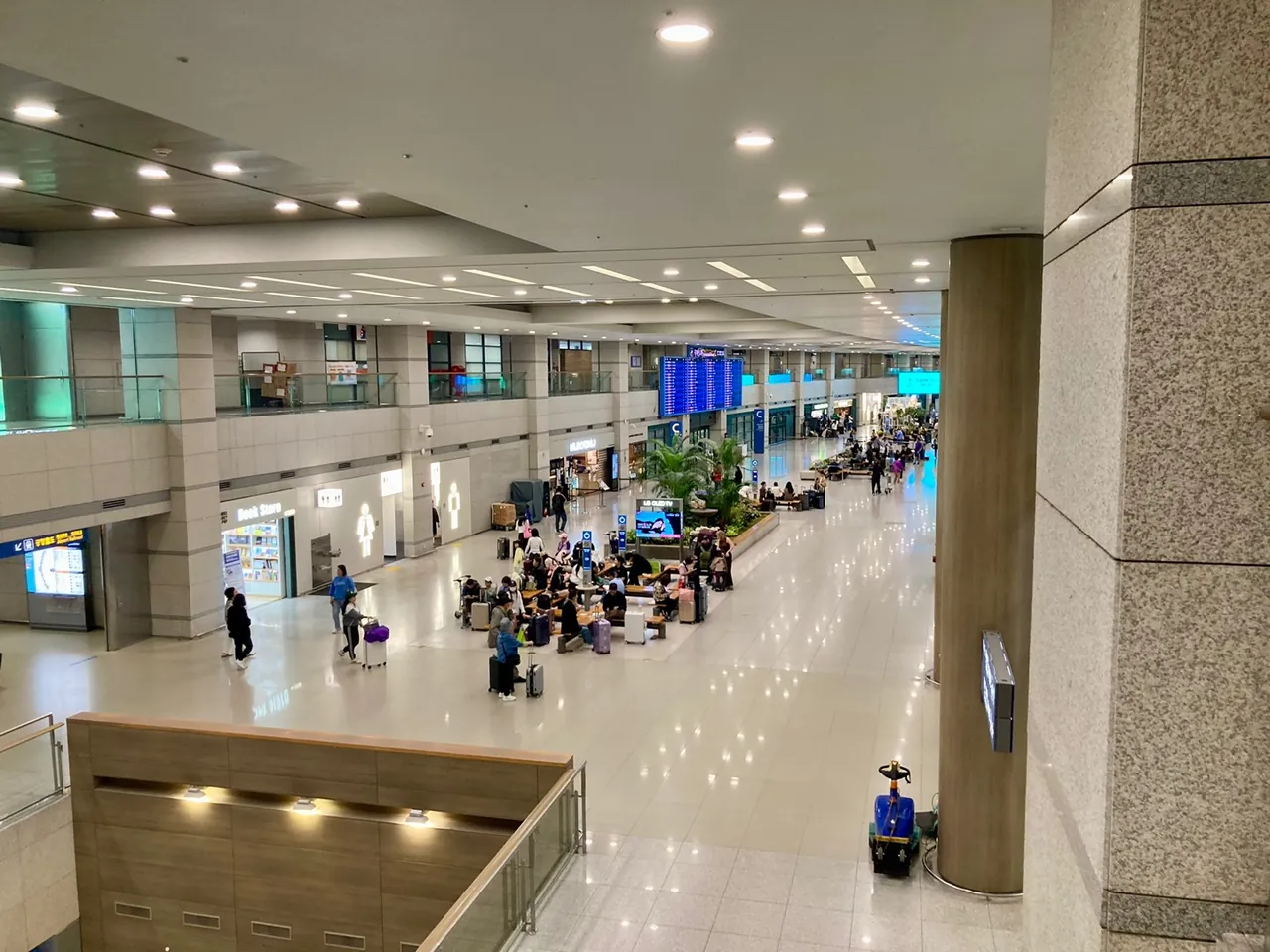
Immigration and baggage claim put you on this floor. Everything below starts here. Narubaru7 (Wikimedia Commons, CC BY 4.0)
Find the blue direction sign. All three options sit on one board — buses and taxis follow the arrow, the railway follows
Airport Railroadand its gate number.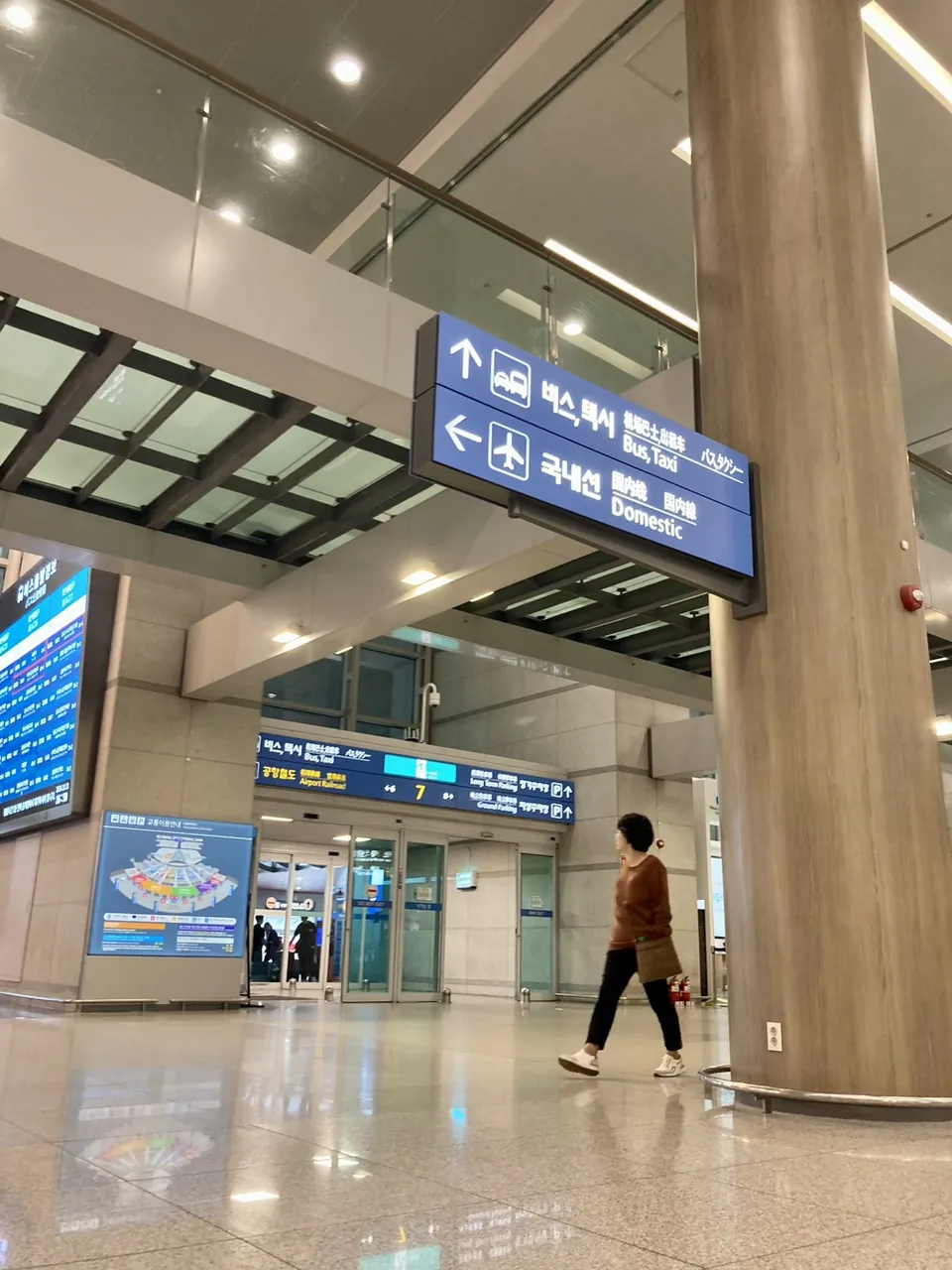
The first sign to look for. All three options are on it: bus and taxi straight ahead, the airport railroad towards gate 7. Narubaru7 (Wikimedia Commons, CC BY 4.0)
From there the routes split, and where you board differs between the terminals.
| From T1 | From T2 | |
|---|---|---|
| AREX | Transportation centre | Transportation centre |
| Airport bus | First-floor bus stops | Bus terminal on B1 of the transportation centre |
| Taxi | Designated taxi rank | Designated taxi rank |
At T1, bus tickets are explained and sold at the indoor and outdoor booths on the first floor; at T2, bus information and tickets are handled at the bus terminal on B1 of the transportation centre.
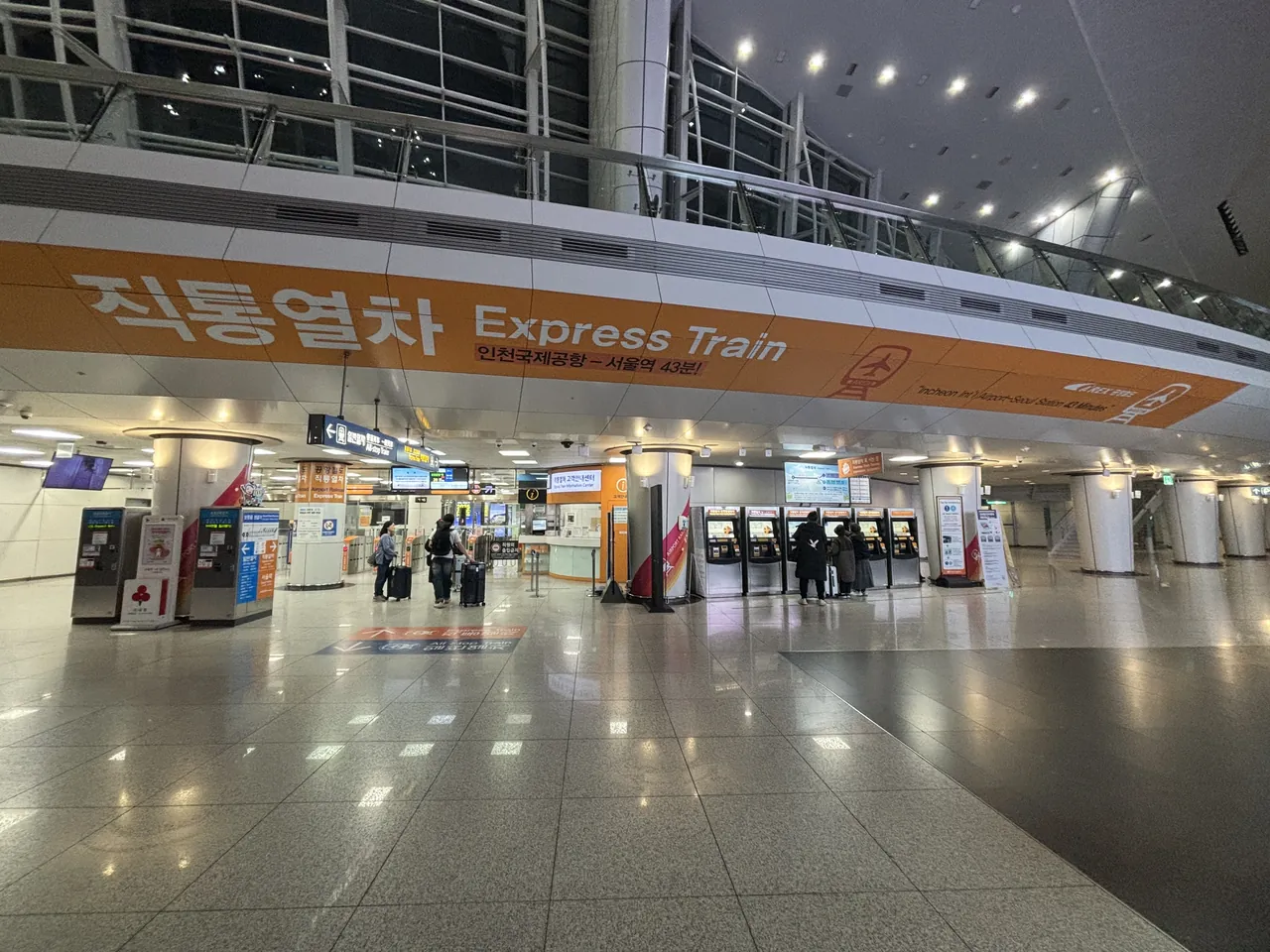
MNXANL (Wikimedia Commons, CC BY-SA 4.0)
Taking AREX into Seoul
The airport railroad links T1 and T2 to Seoul Station. The all-stop train calls at every station; the express runs to Seoul Station without stopping.
| All-stop train | Express train | |
|---|---|---|
| To Seoul Station | T1 KRW 4,750 · T2 KRW 5,350 | Check the operator's booking screen or a station machine on the day |
| Journey time | No published per-station timetable | T1 43 min · T2 51 min |
| Stops | Every station | Non-stop to Seoul Station |
| Seating | Unreserved | Assigned seat |
| Ticket | Transit card, or a single-use card | Separate ticket required |
| Best for | AREX stations other than Seoul, and saving money | Seoul Station, when you want a seat |
The express journey times are in the operator's published timetable, and every weekday and holiday train agrees exactly. Express fares are the opposite case — they appear only on the booking screen, so this guide does not print them.
The all-stop fares are read straight off the railroad's published station-to-station tariff, for an adult paying with a prepaid or postpaid transit card.
All-stop fares
| Destination | Incheon Airport Terminal 1 | Incheon Airport Terminal 2 |
|---|---|---|
| Seoul Station | ₩4,750 | ₩5,350 |
| Gongdeok | ₩4,650 | ₩5,250 |
| Hongik Univ. (Hongdae) | ₩4,650 | ₩5,250 |
| Digital Media City | ₩4,550 | ₩5,150 |
| Magongnaru | ₩4,350 | ₩4,950 |
| Gimpo Airport | ₩4,350 | ₩4,950 |
| Gyeyang | ₩3,850 | ₩4,450 |
| Geomam | ₩3,200 | ₩3,800 |
| Cheongna Int'l City | ₩2,600 | ₩3,200 |
Terminal 2 costs KRW 600 more to every station. AREX fares are charged by distance, and Terminal 2 sits further out.
The row worth a second look is Hongik Univ. If you are staying in Hongdae or Yeonnam-dong there is no reason to ride to Seoul Station. Hongik Univ. is cheaper and saves you a transfer.
What changes with age and payment method
- Children — Aged 6 to under 13. A 550 won base fare, with the per-section distance component at 50% of the adult rate.
- Youth — Aged 13 to 18. A 900 won base fare, with the per-section distance component at 80% of the adult rate.
- Infants — Under 6 travels free, up to three infants per accompanying adult.
- Seniors and other eligible passengers — Free, on presentation of the relevant ID or with a concessionary transit card.
- Single-use card surcharge — The fares above assume a prepaid or postpaid transit card. A single-use card adds 100 won to the adult fare.
- Single-use card deposit — A 500 won deposit on a single-use card, refunded at the destination station.
Transit cards are sold at the convenience stores and vending machines in arrivals. You will use one for the rest of the trip, so buying it here saves queueing again in Seoul. The types and how to top them up are in the transportation card guide.
Follow the signs marked
공항철도 / AREX. From outside the arrivals hall, head towards the transportation centre.Choose the all-stop or the express. If Seoul Station is not your destination, look at the all-stop train first.
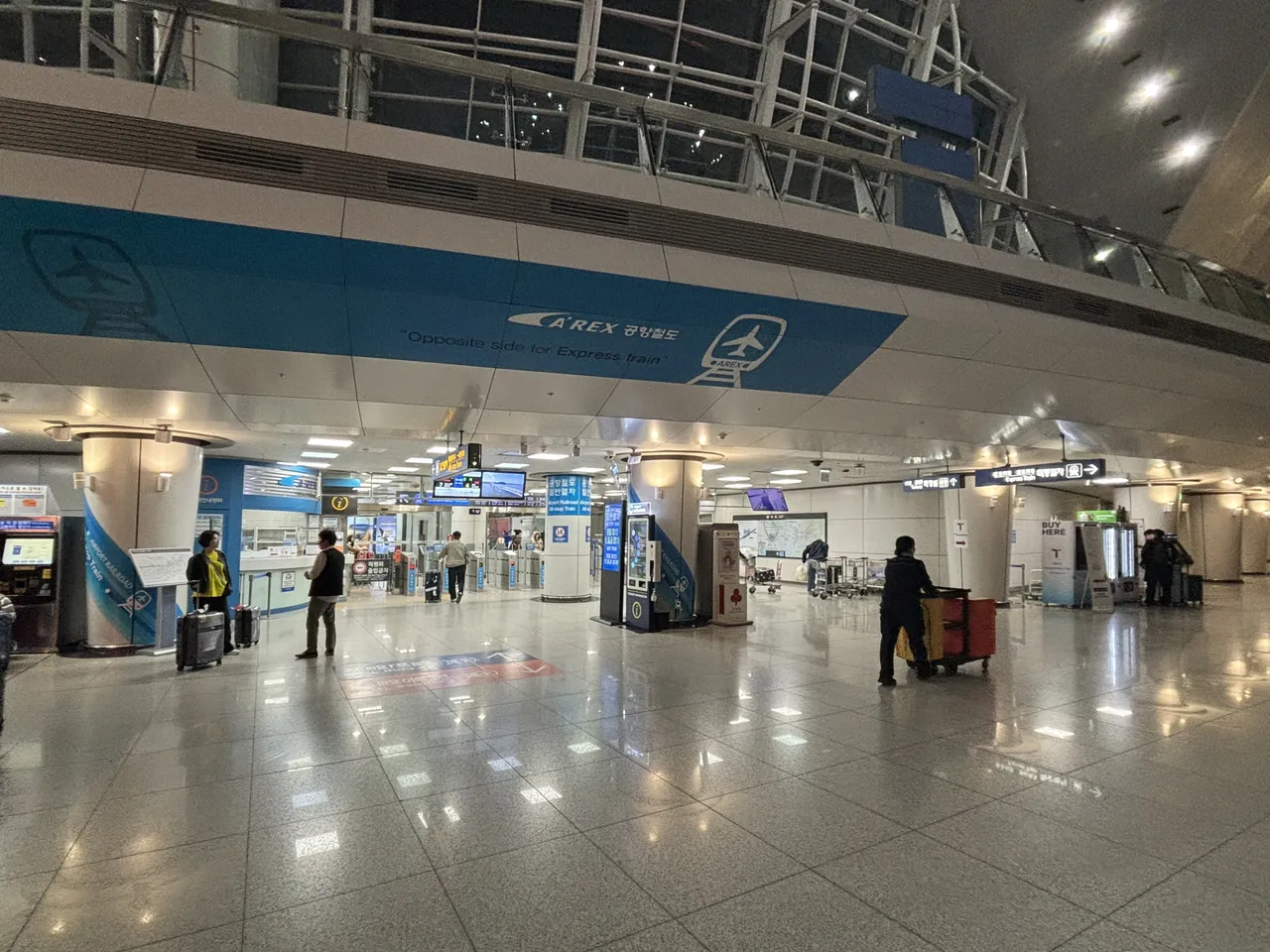
The all-stop side. The banner's Opposite side for Express train is telling you the express platform is the other way. MNXANL (Wikimedia Commons, CC BY-SA 4.0)
Sort out your ticket. The all-stop train takes a transit card straight away; the express needs a separate ticket.
MNXANL (Wikimedia Commons, CC BY-SA 4.0)
Go through the gates and down to the Seoul-bound platform. Check the terminus on the board once before you board.
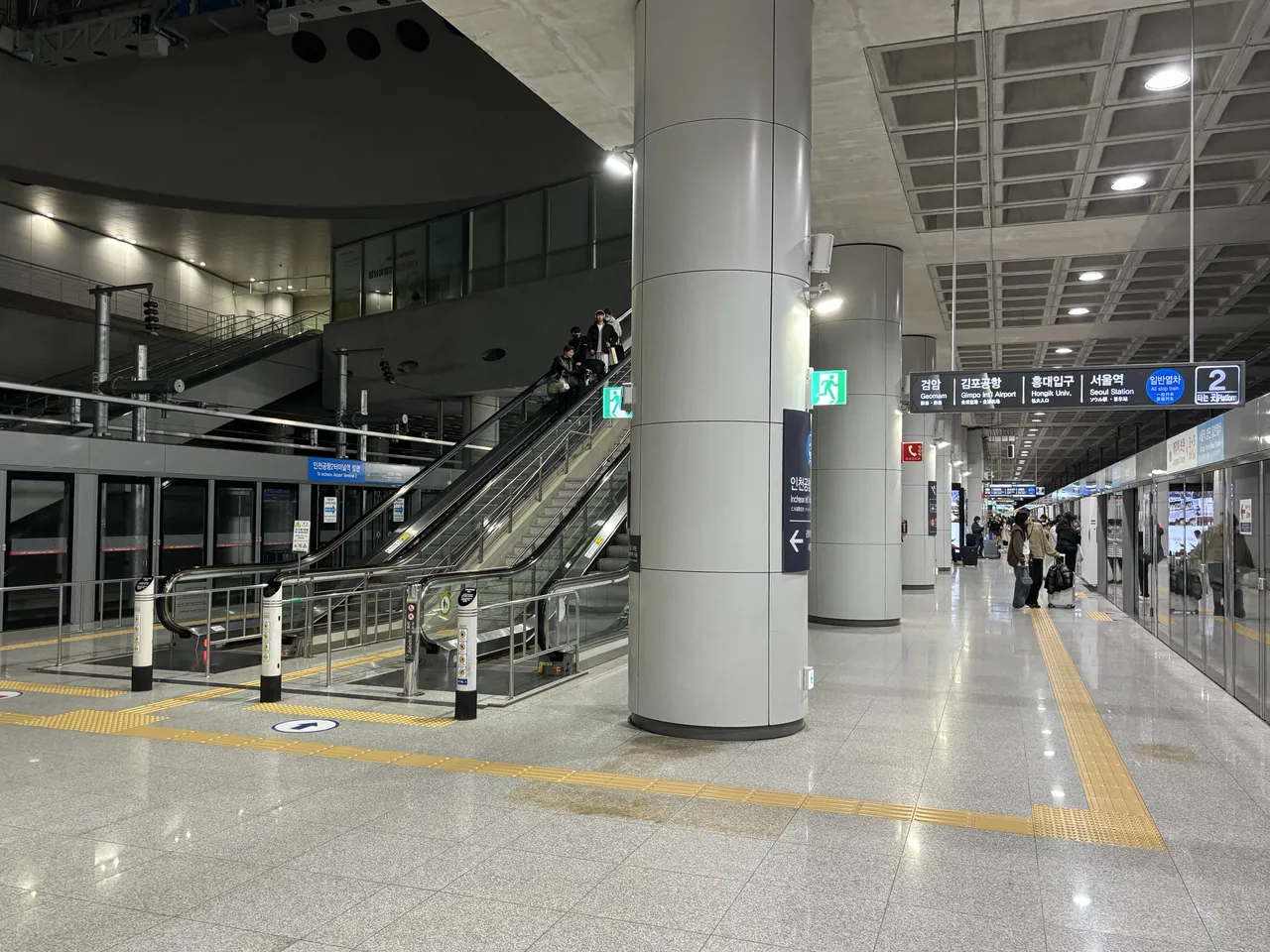
The platform's destination board. Passengers for Hongik Univ. and Gongdeok take this same train. MNXANL (Wikimedia Commons, CC BY-SA 4.0)
Get off at your destination. The all-stop train reaches Hongik Univ. and Gongdeok before Seoul Station, and each of those connects to the subway.
Taking an airport bus into Seoul
Airport buses run directly into Seoul's neighbourhoods and hotel districts. They are the better choice when you would rather find the stop nearest your accommodation than walk to a station and change trains.
The official Airport Limousine routes currently include 6001, 6002, 6005, 6007 and 6015 among others, and routes are revised from time to time. Route 6701 is a separate K Airport Limousine service linking City Hall, Gwanghwamun, Myeongdong, Gongdeok and Mapo with the airport.
| Route | Main areas | Check it if you are staying near |
|---|---|---|
| 6001 | Dongdaemun · Myeongdong · Seoul Station · Sinyongsan | Dongdaemun, Myeongdong, Seoul Station |
| 6002 | Cheongnyangni · Dongdaemun · Jongno · Hapjeong | Jongno, Dongdaemun, Hongdae |
| 6005 | City Hall · Seodaemun · Hongje · Susaek | City Hall, Gwanghwamun |
| 6007 | Yeouido · IFC · Yeongdeungpo · Dangsan | Yeouido, Yeongdeungpo |
| 6015 | Myeongdong · Chungjeongno · Gongdeok · Mapo | Myeongdong, Gongdeok, Mapo |
| 6701 | City Hall · Gwanghwamun · Myeongdong · Gongdeok · Mapo | The hotel districts, City Hall, Gwanghwamun |
That table is a set of representative routes. Do not board on the route number alone — check your accommodation's address against the day's actual services in the official search. Airport Limousine also publishes how tickets are bought and where buses leave from at the airport.
Get your accommodation's exact address. Hotel names repeat, so find the stop name on a map first.
Check the terminal and the route in the airport's official bus search. Confirm whether it runs, and where it leaves from, on the day you travel.
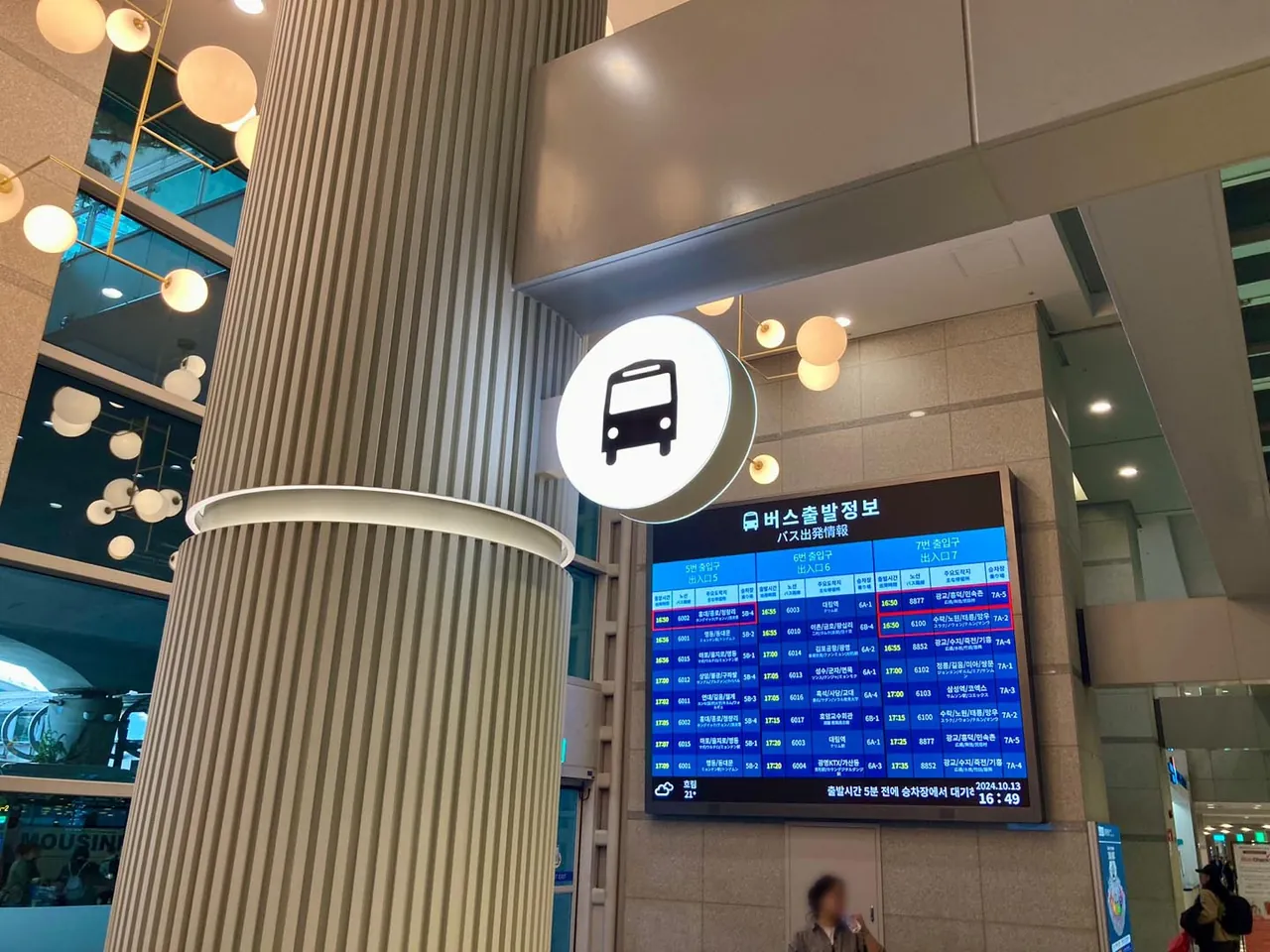
The board pairs each route with which exit and which stand. Knowing only the route number still leaves you hunting for the stand. Narubaru7 (Wikimedia Commons, CC BY 4.0)
At T1 use the first floor; at T2 the B1 bus terminal. Ticketing and boarding information are at both.
Check the number and the direction before boarding. The same number runs both to the airport and into the city.
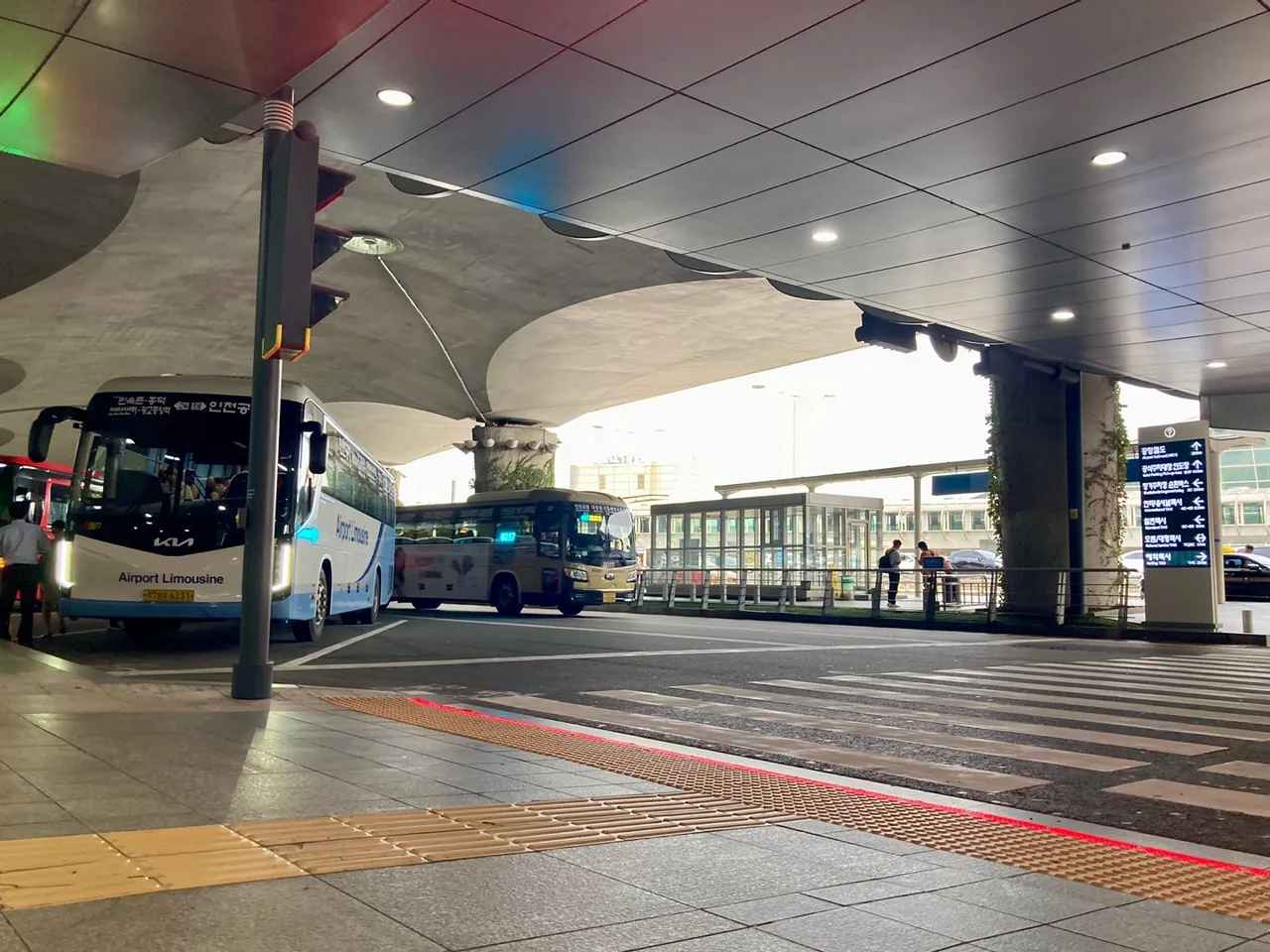
Narubaru7 (Wikimedia Commons, CC BY 4.0)
Taking a taxi into Seoul
A taxi goes to the door with no transfers, which helps with heavy luggage or a group. The airport directs passengers to the designated ranks, and cars that approach you away from them should be refused.
The airport's official guidance lists the rank numbers at T1 and T2 along with base fares for standard, deluxe and large taxis and the late-night surcharge. Check it for current figures before you travel.
Work out which kind of taxi you want, and its stand number. Standard taxis and the deluxe or large ones board at different stands, and the signs around the terminal give the number and the walking distance together.
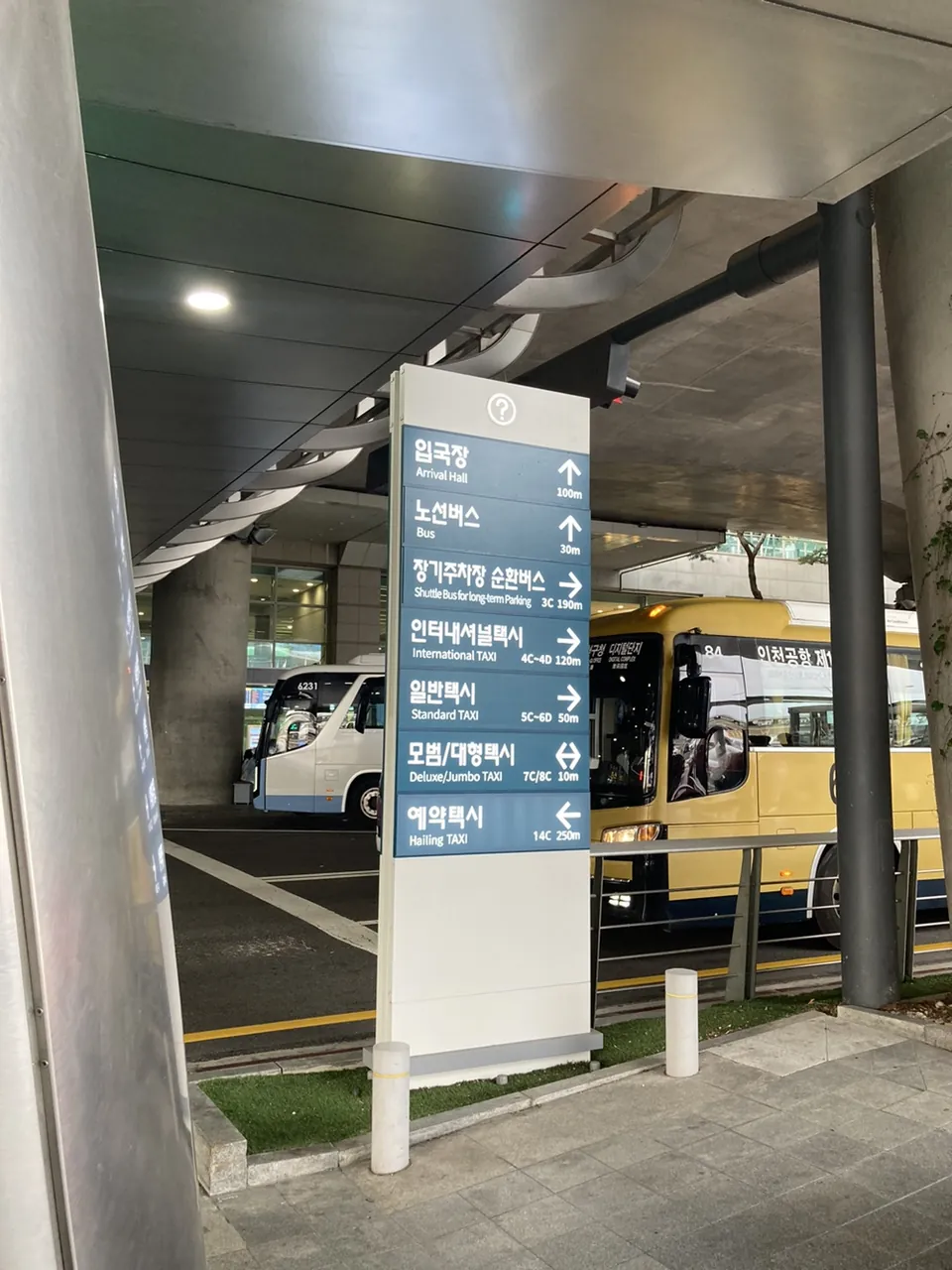
Each kind of taxi has its own stand — standard at 5C–6D, deluxe and jumbo at 7C and 8C. This sign gives the walking distance too. Narubaru7 (Wikimedia Commons, CC BY 4.0)
Join the queue at the designated stand. It is the one marked 택시 타는 곳 / Taxi Stand.
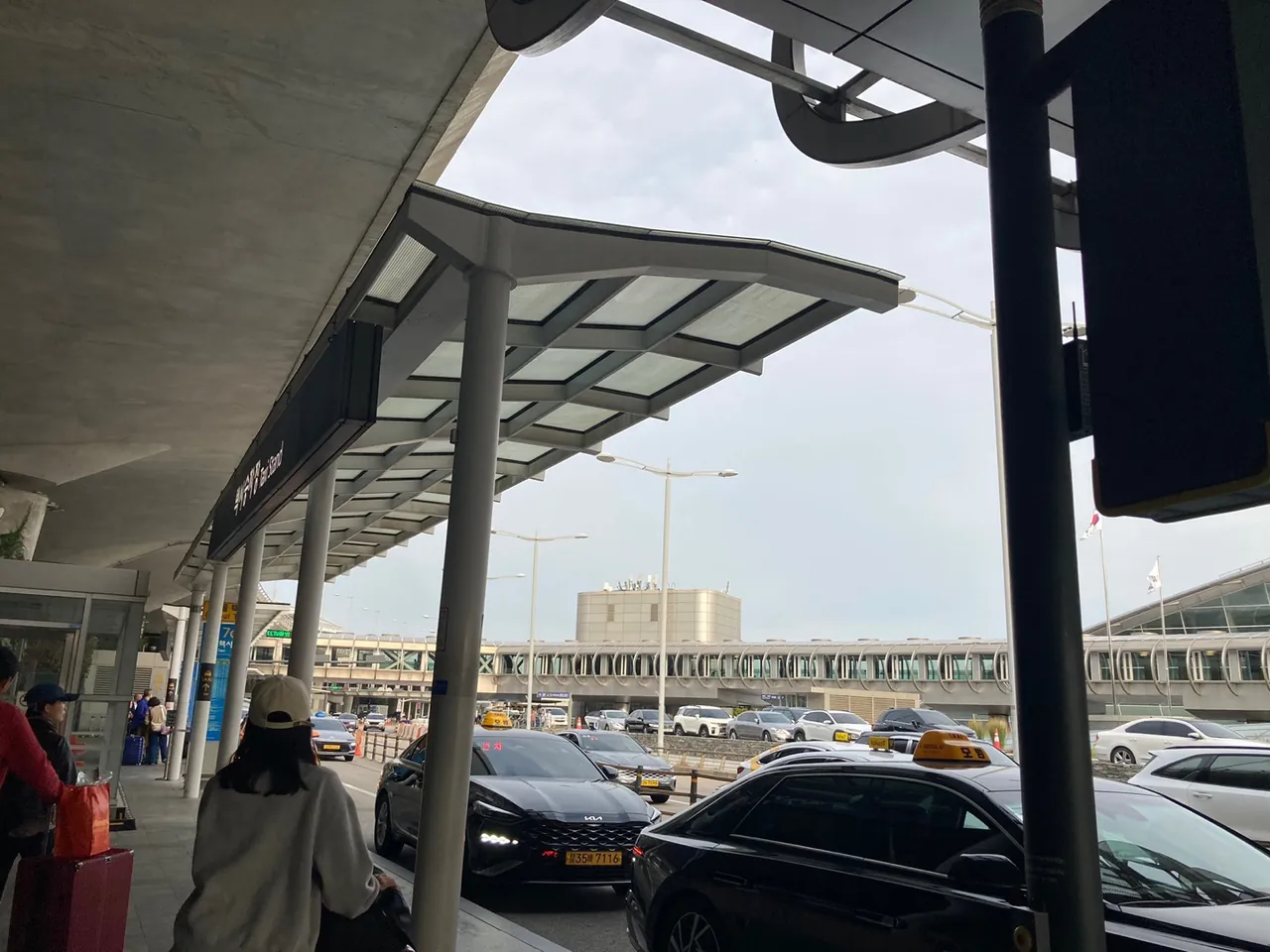
Narubaru7 (Wikimedia Commons, CC BY 4.0)
Take the next car in the queue. The airport asks passengers to use the designated stands, and a driver who approaches you away from one should be turned down.
2. Seoul → Incheon Airport
On the way out, decide in this order: where you are staying → the mode → T1 or T2.
Heading back to the airport
Seoul Station, Hongdae, Gongdeok
If an AREX station is close, take the train. From Seoul Station the express is also an option.
Myeongdong, City Hall, Gangnam and so on
If there is an airport bus stop near your accommodation, you can reach the airport without changing.
Heavy luggage or an early flight
A taxi goes door to terminal, but leave room for traffic.
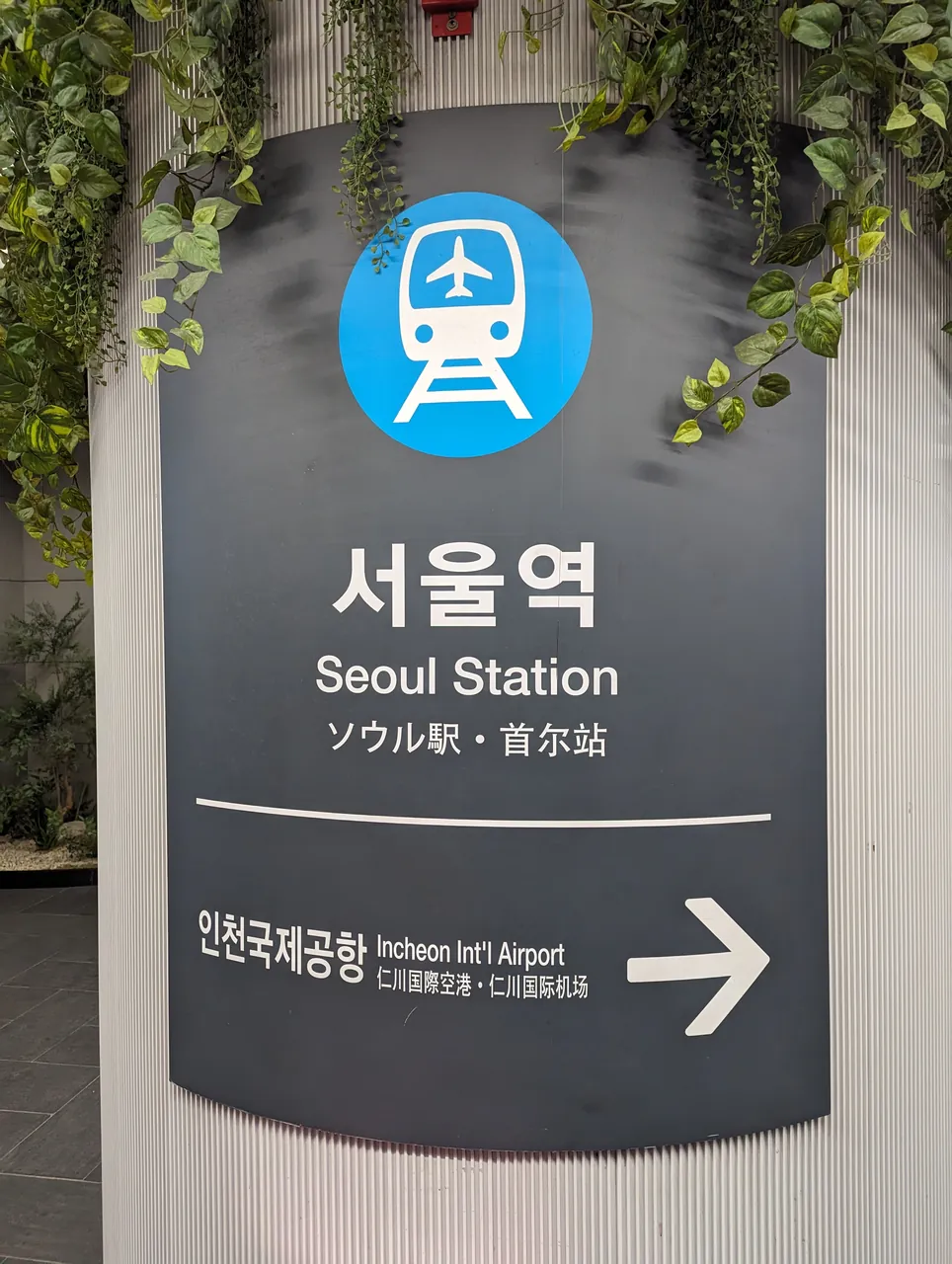
Sean Young (@assanges) (Wikimedia Commons, CC BY 4.0)
Taking AREX out to the airport
From Seoul Station you choose between the express and the all-stop train. The express is the assigned-seat train from Seoul Station to T1 and T2; the all-stop calls at every station on the line.
| Where you're staying | Look at first | Why |
|---|---|---|
| Seoul Station | AREX, express or all-stop | The line starts here |
| Hongdae and Yeonnam | AREX all-stop | Board towards the airport at Hongik Univ. |
| Gongdeok | AREX all-stop | Board towards the airport at Gongdeok |
| Myeongdong | AREX or an airport bus, depending on the address | Either travel to Seoul Station or use the nearest bus stop |
| Gangnam | Airport bus, or subway plus AREX | The number of transfers depends on where you are |
If you want a seat on the day you fly, the express takes 43 minutes to T1 and 51 to T2.
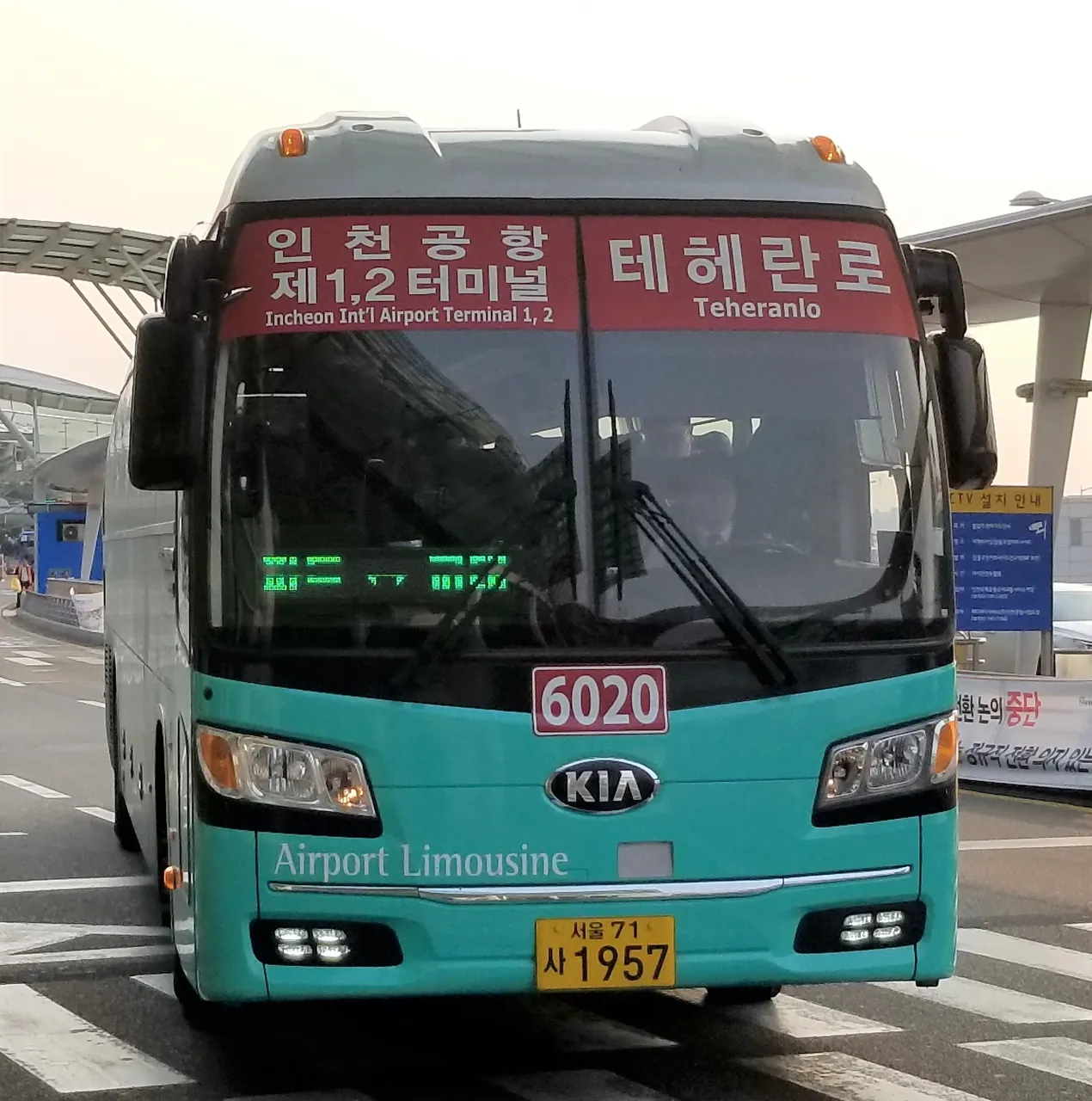
hyolee2 (Wikimedia Commons, CC BY-SA 4.0)
Taking an airport bus out to the airport
If there is an airport-bound stop near your accommodation you can cut out the transfers. From Myeongdong, City Hall, Gwanghwamun, Yeouido and Gangnam in particular, start by finding the route closest to where you are staying.
Airport Limousine publishes operating hours and stop lists per route, and the airport-bound and city-bound directions have to be checked separately.
On the day you fly, confirm your flight's terminal first, then check that the bus you board goes to that terminal.
Taking a taxi out to the airport
The advantage is going straight from your accommodation to the terminal. Seoul traffic can change the journey time considerably, so if your departure time is fixed, leave earlier than you think you need to.
The airport's official taxi guidance covers the ranks and fare information by terminal, but the actual fare leaving Seoul depends on where you start and on traffic.
Frequently asked questions
What is the cheapest way from Incheon Airport to Seoul Station?
The AREX all-stop train. For an adult paying with a prepaid or postpaid transit card it is KRW 4,750 from Terminal 1 and KRW 5,350 from Terminal 2. Express fares are absent from the document the operator's server sends, so they are not printed here — read them off the ticket machines and boards at the station on the day.
Should I take the express or the all-stop train?
Take the express if Seoul Station is your destination and you want an assigned seat. Take the all-stop if you are getting off earlier at Hongik Univ. or Gongdeok, or if you want to save money. The express takes 43 minutes from Terminal 1 and 51 minutes from Terminal 2.
Can I get off at Hongik Univ. station?
On the all-stop train, yes. It is KRW 4,650 from Terminal 1 — KRW 100 less than Seoul Station — and it saves you a subway transfer. The express does not call there, because it runs non-stop to Seoul Station.
Does the fare depend on which terminal I'm at?
Yes. AREX fares are charged by distance and Terminal 2 sits further out, so every Seoul-bound station costs KRW 600 more from there. To Seoul Station it is KRW 4,750 from Terminal 1 and KRW 5,350 from Terminal 2.
I went to the wrong terminal. Can I travel between them?
Yes. The same AREX train connects them for KRW 1,200 on an adult transit card. They are more than 15 km apart, so walking is not possible.
Are the bus stops the same at T1 and T2?
No. The boarding points differ. At Terminal 1 work from the first-floor bus stops and ticket booths; at Terminal 2 work from the bus terminal on B1 of the transportation centre.
Do I need to buy an airport bus ticket in advance?
It depends on the route and the terminal. Airport Limousine in particular has required Seoul-bound tickets at Terminal 2 to be bought before boarding since 5 March 2026, so check the operator's and the airport's current guidance before you travel.
What if I land at Incheon late at night?
Check the day's last AREX train and last airport bus first. First and last departures shift with the day of the week and the season, so confirm the actual times before you fly; outside public-transport hours, use the airport's official taxi rank.
Where the train can take you

KT&G Sangsangmadang Hongdae
Walkable from Hongik Univ. station, which AREX serves directly — no need to route via Seoul Station.

Shinsegae Department Store Main Store
One subway stop from Seoul Station. A natural first stop if you are staying in Myeongdong.

Namdaemun Market
Between Seoul Station and Myeongdong, and much of it opens early — useful while you are still jet-lagged.
Nearby Food
- Five Seoul Korean Barbecue Restaurants: Hanwoo, Galbi, Bulgogi and Pork Belly

- What the broth is made of — eight Seoul houses, seven different bases

- Northern Korean Food in Seoul: Naengmyeon, Eobok-jaengban, Mandu and Kongbiji

- Seven Seoul houses that open for breakfast — before eight in the morning

- Six Seoul houses that make the noodle by hand — kalguksu, guksi, sujebi

- How to Use Seoul Cafes: Neighbourhoods, Ordering and Seating

Travel Guides


Related articles
- How to Use a Transportation Card in Korea

- Can You Use Google Maps in Korea?

- A Foreigner’s Guide to Shopping at Olive Young
- How to Use Korean Convenience Stores: From Heating a Meal to Topping Up a Transit Card

- At a Korean Convenience Store, the Thing to Read Is the Package

- Eating Alone in Korea: How to Read Menus and Order for One

Last verified:
Official sources
- Fact check: Incheon Airport — official list of which airlines use which terminal (2026-08-31)
- Fact check: Incheon Airport Terminal 1 — bus ticketing, at the indoor and outdoor booths on the first floor (2026-08-31)
- Fact check: Incheon Airport Terminal 2 — bus ticketing, at the bus terminal on B1 of the transportation centre (2026-08-31)
- Reference: Incheon Airport — official bus search and per-terminal boarding points (2026-08-31)
- Fact check: Incheon Airport — official taxi guidance and the T1/T2 ranks (2026-08-31)
- Fact check: Incheon Airport — official inter-terminal transfer guidance. Both the airport railroad and a shuttle bus connect them (2026-08-31)
- Fact check: Airport Railroad — station-to-station fare table for the all-stop train (adult, transit card). Every fare below was read off this table (2026-08-31)
- Fact check: Airport Railroad express timetable (weekday and holiday). Departure and arrival times for all 52 trains are in the served HTML, and the per-section duration is identical on every train (2026-08-31)
- Reference: Airport Railroad — service landing page. Express-train fares render in JavaScript only and are absent from the served HTML; the fare table page is the one that arrives server-rendered
- Reference: Airport Limousine — official route guide. Routes 6001, 6002, 6005, 6007 and 6015 among others serve central Seoul, with operating details per route (2026-08-31)
- Fact check: Airport Limousine notice — from 5 March 2026, Seoul-bound tickets at Incheon Airport Terminal 2 must be bought before boarding (2026-08-31)
- Fact check: K Airport Limousine route 6701 — Incheon Airport to City Hall and Gwanghwamun, serving both T1 and T2 (2026-08-31)
Photo credits
- Photo: Hannah Park (Unsplash)
- Photo: AREX concourse at Incheon Airport T1, MNXANL / Wikimedia Commons, CC BY-SA 4.0
- Photo: bus boarding area at Incheon Airport T1, Narubaru7 / Wikimedia Commons, CC BY 4.0
- Photo: taxi stand at Incheon Airport T1, Narubaru7 / Wikimedia Commons, CC BY 4.0
- Photo: AREX sign at Seoul Station, Sean Young (@assanges) / Wikimedia Commons, CC BY 4.0
- Photo: airport-bound Airport Limousine coach, hyolee2 / Wikimedia Commons, CC BY-SA 4.0