Paju DMZ Peace Tour Guide
Paju's own three-hour bus into the Civilian Control Zone. The departure you book decides whether you ride the monorail or walk, and 4,200 won of the price is the bus.
Language

Place information
- Korean name
- 제3땅굴
- Address
- 210-358 Je3ttangul-ro, Gunnae-myeon, Paju, Gyeonggi-do
- Opening hours
- Reached only on the DMZ Peace Tour, which sells on the day from 09:00 to 14:30 at Imjingak and often sells out earlier. Individual shuttles leave ten times a day Tuesday to Friday and fourteen times at weekends; each departure is designated monorail or walking. Collection closes 20 minutes before departure for an online booking and 10 minutes before for a walk-up.
- Closed
- Closed every Monday, on public holidays that fall on a weekday, and on Seollal and Chuseok themselves — though the rest of those holidays operate normally. Paju adds that the whole schedule can stop without notice for a security situation or bad weather, cancelling existing bookings.
The DMZ Peace Tour is a three-hour bus run by Paju City, not a travel agency, and it is the only way to reach the Third Tunnel and Dora Observatory without your own coach. Almost everything a visitor gets wrong about it is in the fee table: the largest single component of the price is the shuttle bus, and whether you ride the monorail is decided by the departure time you book.
At a glance
Three hours, four stops
Imjingak → Third Tunnel → Dora Observatory → Unification Village → Imjingak, in that order or reversed.
9,200 or 12,200 won
The difference is the monorail into the tunnel. 4,200 of either figure is the shuttle bus, not the sites.
Physical ID or no ticket
Checked before you can buy. A screenshot is refused, and so is an expired passport. Foreigners get no discount by city ordinance.
Sales close at 14:30, often sooner
Only 14 of each 44-seat shuttle can be reserved online. The rest is same-day and it sells out.
What the price is actually made of
Paju publishes the fare as three separate charges added together, which is the most useful table on the whole site because it shows where the money goes.
| Total | Facility | Monorail lift | Shuttle bus | ||
|---|---|---|---|---|---|
| Individual, adult | monorail | 12,200 | 5,000 | 3,000 | 4,200 |
| Individual, adult | on foot | 9,200 | 5,000 | — | 4,200 |
| Child / student | monorail | 9,500 | 3,300 | 2,500 | 3,700 |
| Child / student | on foot | 7,000 | 3,300 | — | 3,700 |
| Senior, 65+ | monorail | 7,700 | 2,500 | 1,500 | 3,700 |
| Senior, 65+ | on foot | 6,200 | 2,500 | — | 3,700 |
| Exempt: veterans, disabled | monorail | 5,200 | waived | 1,500 | 3,700 |
| Exempt: veterans, disabled | on foot | 3,700 | waived | — | 3,700 |
| Group of 30+ with own coach | on foot | 4,000 | 4,000 | — | — |
Two things fall out of it. The site itself costs 5,000 won; the other 4,200 is transport you cannot opt out of unless you bring a 45-seat coach. And a group that does bring one pays 4,000 won a head — a third of the individual monorail price for the same three hours, because both the bus and the lift drop out of the calculation.
The exemption row is the sharpest illustration: a registered veteran or disabled visitor has the facility fee waived entirely and still pays 3,700 won, because that is the bus.
Groups have to be 30 to 45 people excluding the driver, in a chartered 45-seater — a private minibus does not qualify.
The departure time decides how you see the tunnel
Course A is Imjingak → Third Tunnel → Dora Observatory → Unification Village → Imjingak, about three hours. Groups can book it in reverse, observatory first, which Paju's FAQ confirms visits exactly the same four places.
The individual shuttle runs ten times a day Tuesday to Friday and fourteen times at weekends — Tuesday to Friday because Monday is closed. Crucially, Paju marks each departure in advance as either monorail or on foot:
| Departures | |
|---|---|
| Tue–Fri | 9:20 mono · 9:40 foot · 10:00 mono · 10:30 foot · 11:30 mono · 12:30 foot · 13:00 mono · 13:30 foot · 14:00 mono · 14:40 foot |
| Sat–Sun | 9:20 mono · 9:40 foot · 9:50 foot · 10:00 mono · 10:30 foot · 11:00 foot · 11:30 mono · 12:30 foot · 13:00 mono · 13:30 foot ×2 · 14:00 mono · 14:40 foot ×2 |
So the choice between riding and walking is made when you pick a time, not at the tunnel mouth. There are five monorail departures a day and they are the same five whatever the day of the week. If the monorail breaks down, Paju converts that departure to walking.
Only 14 of each shuttle's 44 seats are available to individual online booking; the rest is sold on the day at Imjingak. Collection closes 20 minutes before departure for an online booking and 10 minutes before for a walk-up.
One change already in force: since 1 August 2026 the stop at Unification Village has been extended from 15 to 25 minutes, on weekday departures 6–10 and weekend departures 8–14. A second change lands on 1 September 2026, but it revises the group coach timetable only — the individual schedule above is unaffected.
The tunnel, and who is turned away from it
The Third Infiltration Tunnel was found because a defector, Kim Bu-seong, said on 5 September 1974 that he had surveyed tunnels on the southern side. Nothing was found for three years. Then on 10 June 1978 a test borehole produced an explosion and a spout of water, and the tunnel was underneath.
Paju's figures: 1,635 m long, 2 m wide, 2 m high, 12 km from Munsan and 52 km from Seoul, able to move 30,000 troops an hour. The shuttle lift runs nine times a day so that visitors do not have to walk the descent.
The restrictions are published as a list rather than a warning, and they are worth reading before booking for someone else:
- Elderly visitors, anyone with high or low blood pressure, anyone physically frail, anyone with breathing difficulty and anyone who has been drinking may be refused entry to the tunnel.
- Wheelchair users and visitors with limited mobility may be refused, because the interior is cramped and steeply graded.
- Since 7 May 2026, watching the film in the DMZ theatre is mandatory for everyone, individuals and groups, immediately on arrival. Paju introduced it as a crowding and safety measure for the walking route, not as an attraction.
Dora Observatory, and the list of what you can see
Dora Observatory replaced the closed Songaksan OP as the northernmost observatory on the southern side. It opened to the public in January 1987 and the current building was rebuilt and relocated in October 2018; Paju gives it 500 seats and around 800,000 visitors a year.
What is on the other side is itemised rather than gestured at: Songhaksan in Kaesong, the Kim Il-sung statue, Kijong-dong, the outskirts of Kaesong and the Geumam-gol collective farm, with the Kaesong Industrial Complex visible on a clear day.
The telescopes are a separate operation from the tour and have their own clock: 34 of them, 31 for visitors and 3 reserved for the military, 10:00 to 17:00, closed Mondays, 500 won for two minutes, with two coin machines and an exchange booth on site.
Rules that are not suggestions
This is an active military area and Paju words its conditions accordingly.
- Photography and video are banned across the entire course, drones included.
- Outside the designated roads is uncleared mine field. Do not step off.
- No firearms, hazardous items, alcohol or fishing tackle; no trapping wildlife, no foraging, no littering.
- CCTV operates inside the Demilitarized Zone for visitor safety and control.
- There is no guide. Paju provides none, and a group that wants one has to bring its own.
- The Dorasan shuttle train has its own separate entry procedure at Imjingang and Dorasan stations.
- Everything can stop without notice for a security situation or bad weather, and existing bookings can be cancelled with it.
Who pays less, and who does not
Half price goes to single-parent families, seniors, anyone holding a voting certificate for up to three months after the election, Paju multi-child families, employees of family-friendly certified companies, state guests and officials on duty, and residents of Paju, of the border municipalities, and of the "-ju" cities — Gyeongju, Gongju, Gwangju, Naju, Sangju, Yangju, Yeoju, Yeongju, Wonju, Jeonju, Jeju, Jinju, Chungju and Paju, under a reciprocal agreement between them.
Free entry goes to model volunteer cardholders, children of 6 and under with a guardian, registered disabled visitors plus one carer for severe disability, and a long list of veterans' categories — including returned prisoners of war and the families of those detained in the North.
And one line that matters to most readers of this page: foreign visitors are not eligible for any reduction, by Paju City ordinance. The tour's own English service is, in the operator's words, still in preparation.
Nearby
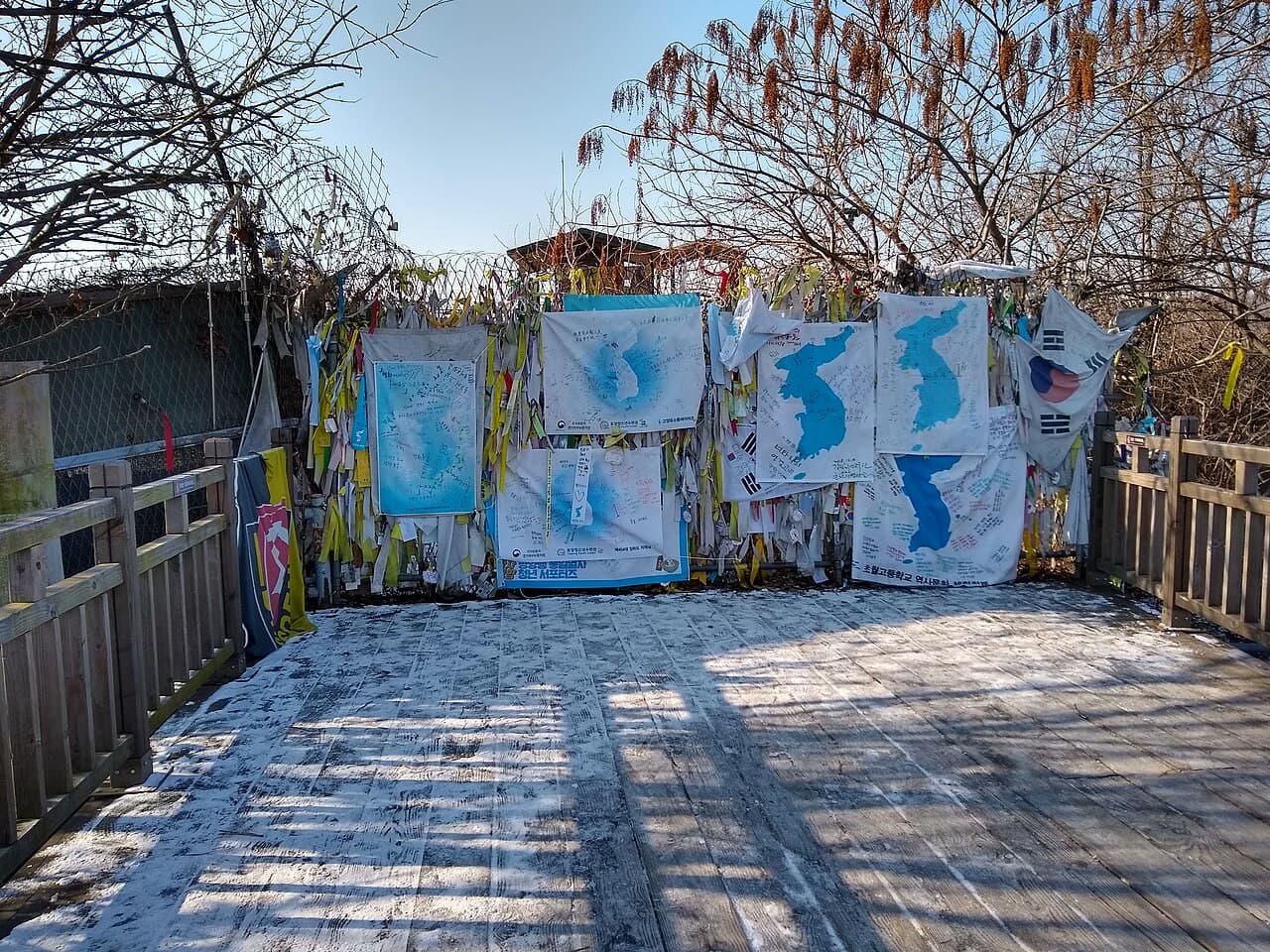
Imjingak
Where the tour starts and ends. Free, open and the only part of this that needs no ID.
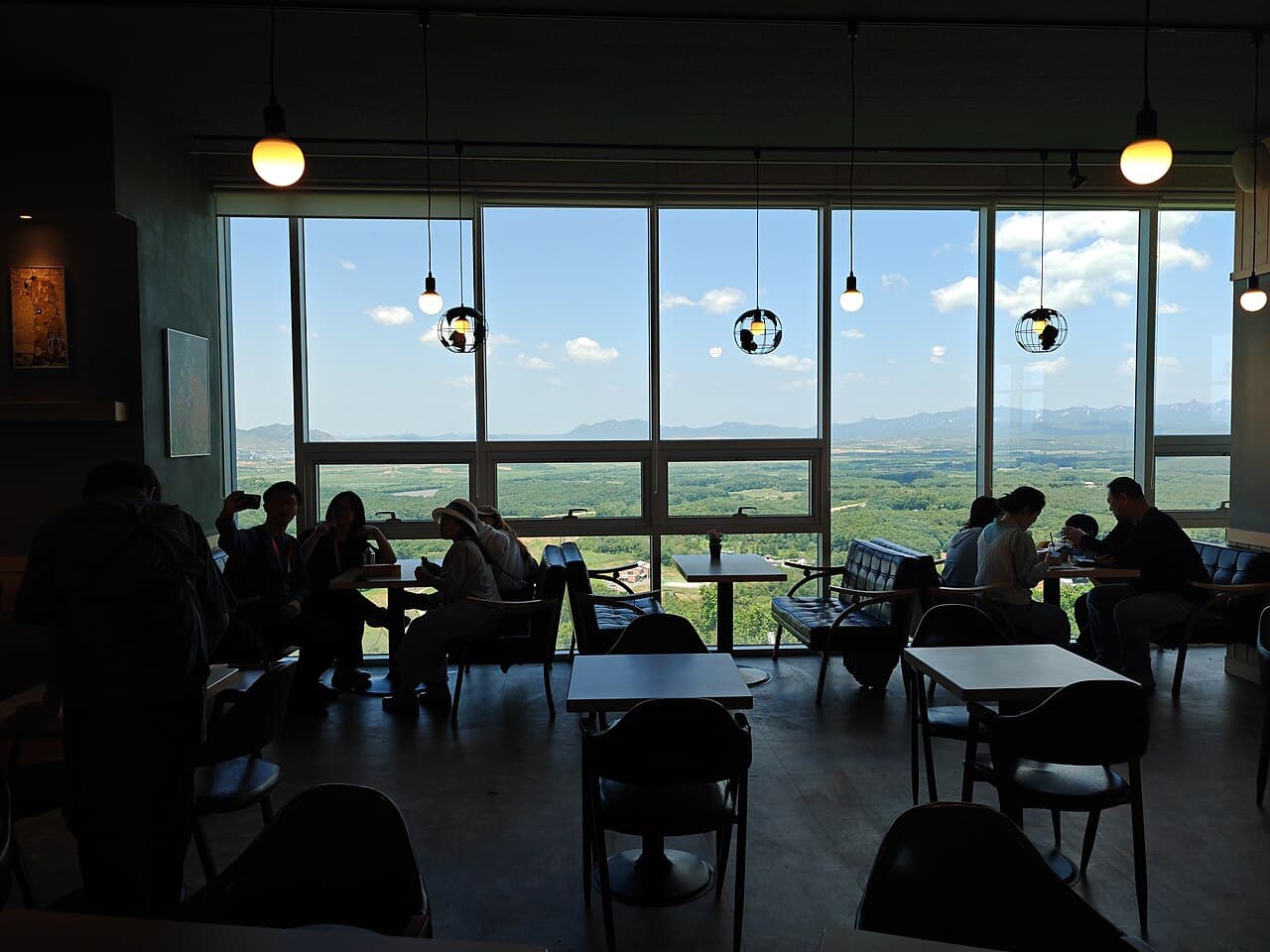
Dora Observatory
The second stop, and the reason most people book. Its telescopes keep their own hours.
Frequently asked questions
How much is the Paju DMZ Peace Tour?
9,200 won for an adult walking into the tunnel and 12,200 with the monorail. Of either figure, 5,000 is the facility fee and 4,200 is the shuttle bus. A group of 30 or more with its own coach pays 4,000.
Can I drive to the Third Tunnel or Dora Observatory?
No. Both are inside the Civilian Control Zone and private cars are barred. The city's shuttle from Imjingak is the way in unless you bring a chartered 45-seat coach with 30 to 45 people.
Do I choose the monorail or is it assigned?
It is set by the departure. Paju marks each shuttle in advance as monorail or on foot — five monorail departures a day — so you choose it when you pick a time. If the monorail fails, that departure converts to walking.
What ID do I need?
A physical resident registration card, driving licence or passport for Koreans; a passport, alien registration card or US military ID for foreigners. Screenshots and photographs of an ID are refused, as is an expired passport. Only three mobile IDs are accepted and PASS-type carrier apps are not among them.
When is it closed?
Every Monday, on public holidays that fall on a weekday, and on Seollal and Chuseok themselves — the rest of those holiday periods run normally.
How late can I turn up?
Sales run 09:00 to 14:30 and frequently close earlier when departures sell out. Ticket collection closes 20 minutes before departure for an online booking and 10 minutes before for a walk-up.
Can I take photographs on the tour?
No. Paju states that photography and video across the whole course are banned, drones included.
Is there a guide?
No. Paju provides no guide or commentator on the DMZ Peace Tour. A group that wants one has to arrange it themselves and bring them along.
Do foreign visitors get a discount?
No. Paju City's ordinance on tourism facility charges does not make foreigners eligible for any reduction, and the operator says so explicitly.
Nearby Attractions


Nearby Food


Travel Guides


Suggested Next Destinations


Related articles

Last verified:
Official sources
- Fact check: Paju DMZ Peace Tour — visitor rules, ID requirement, closing days and ticketing hours
- Fact check: Paju DMZ Peace Tour — fare table, component charges and the discount and exemption list
- Fact check: Paju DMZ Peace Tour — Course A, individual and group shuttle timetables
- Fact check: Paju DMZ Peace Tour — FAQ on ticket collection deadlines, course direction and guides
- Fact check: Paju City tourism — Third Infiltration Tunnel dimensions, discovery and entry restrictions
- Fact check: Paju City tourism — Dora Observatory, telescopes and 2018 rebuild
Photo credits