National Museum of World Writing Systems Guide
Free, eight minutes from the subway, and it holds a leaf of the Gutenberg Bible. The only thing that costs money here is the car park.
Language

Place information
- Korean name
- 국립세계문자박물관
- Address
- 217 Central-ro, Yeonsu-gu, Incheon (Songdo-dong 24-8)
- Opening hours
- Tue 10:00–18:00 · Wed 10:00–18:00 · Thu 10:00–18:00 · Fri 10:00–18:00 · Sat 10:00–18:00 · Sun 10:00–18:00 · Last admission 17:30
- Closed
- Closed every Monday, on 1 January and on Seollal and Chuseok themselves. When a public holiday falls on a Monday the museum opens that day and closes the next weekday instead. The car park runs 09:30-19:00, wider than the museum's own hours.
A leaf of the 42-line Gutenberg Bible sits in a new town in Incheon, eight minutes from a subway exit, and it costs nothing to look at. The museum around it has been open since June 2023 and passed three million visitors in March 2026, and most guides to Songdo still lead with the skyline.
At a glance
Free
Admission is free apart from charged special exhibitions. Tue–Sun 10:00–18:00, last entry 17:30.
The Gutenberg Bible is here
Part 2 of the permanent gallery displays a leaf of the 42-line Bible, Germany, c. 1454, alongside Pliny's Natural History of 1476.
536 m from Central Park station
Exit 3, past the Tri-bowl, over the GCG bridge. The operator gives it as about eight minutes.
The car park is the only till
600 won for the first 30 minutes, 6,000 a day — but free if you are out within 20 minutes of driving in.
The Monday rule, and why it matters 300 m away
The museum closes every Monday, on 1 January and on Seollal and Chuseok themselves. The clause worth reading is the next one: when a public holiday falls on a Monday the museum opens that Monday and closes the following weekday instead.
The Incheon Urban History Museum, 300 m away across the same park, keeps a Monday rule that looks identical and is not. It also closes Mondays, and a Monday that is a public holiday also opens — but its operator publishes no replacement closure. So on the Tuesday after a Monday holiday, one of these two free museums is shut and the other is not, and it is the national one that is shut.
Both stop admitting 30 minutes before closing. The Urban History Museum runs 09:00–18:00, an hour earlier than this one, which is the other reason to take them in that order.
What the permanent gallery is arranged to say
The permanent exhibition is called Civilization and Writing: A Great Journey, occupies 2,064 m², and is built as an argument rather than a collection.
- Prologue, "A Great Invention" — speech disappears the moment it leaves the mouth. Writing is the invention that let humans escape that.
- Part 1, "Writing Systems to Build a Road" — nine scripts side by side: cuneiform, Egyptian, Maya, Latin, Aramaic, Indic and South-East Asian, Chinese characters, Hangeul, and Hunmaengjeongeum, Korean braille. The museum's own framing is that roughly 400 writing systems have been used in history and about 30 survive in use.
- Part 2, "Writing Systems to Create Culture" — printing, translation, records, media, typefaces. This is where the Gutenberg leaf sits, with the Goryeo Mahaprajnaparamita Sutra volume 534 printed after 1239, Pliny's Natural History of 1476, an 18th-century Indian narayam stylus and a French penner of about 1740.
- Epilogue, "Writing of Tomorrow" — the digital argument, ending on the observation that humanity went from pictures to writing and is going back to pictures.
Named objects in Part 1 include a Sumerian round-boat clay tablet of 2000–1600 BC, a Greek black-figure amphora of 540–530 BC, a Roman marble cinerary urn, an Egyptian canopic jar, an Arabic Qur'an of 1300–1330, a Nepalese Pancharaksha palm-leaf sutra of 1397 and a Manchu dictionary of 1771.
It was built to be touched, and that is documented
The museum states that it applied universal design as a standard to the permanent gallery, and the specifics are unusually concrete:
- Some objects are shown open, without a case, so they can be touched.
- In the Hunmaengjeongeum section of Part 1, a braille panel and a raised-Hangeul panel are placed side by side.
- Tactile tables carry models of an object's shape and its script, with braille, audio guidance and digital pads.
- The Hunmaengjeongeum section also carries a sign-language video.
Pushchairs and wheelchairs are lent at the level 1 desk against an ID or credit card, indoors only, with pushchairs limited to children under 24 months.
The prohibitions are ordinary except for one: no bicycles, kickboards, skateboards or wheeled shoes anywhere in the museum, which is a rule written by a building that opens straight onto a park path. Also no smoking anywhere, no food brought in, no pets except assistance dogs, no flash, no tripods, and phones off or silent in the galleries.
The children's gallery is for five- to seven-year-olds, and you have to book
An adventure of Writing with Kkaebi is a booked, ticketed-by-reservation experience, not a room you wander into. The museum states it suits ages 5 to 7, that every child must be with a guardian, and that a party is four people including the guardian, or 10 to 30 including a leader for a group.
You reserve online, confirm at the level 1 entrance and are given an ID card with an avatar that you carry round six zones: a secret-code gate, Egyptian hieroglyph blocks, a make-the-letter-with-your-body dance, a jungle where touching the scenery turns it into script, an Arabic-writing playground, and a map-and-magnifier "script laboratory".
A free museum with a paid car park, and the discount table is where the terms are
Parking runs 09:30 to 19:00 — wider than the museum's own hours — with 72 outdoor spaces (2 accessible) and 79 underground (4 accessible, 8 with EV charging).
The charge is 600 won for the first 30 minutes, 300 for every 15 after it, capped at 6,000 a day. It is free if you leave within 20 minutes of arriving, the machines are unmanned and card-only, and you must be out within 20 minutes of paying or the meter restarts.
The discounts are where this stops being routine:
| Discount | |
|---|---|
| Official and emergency vehicles, staff, volunteers, donors, patrons, contractors | Free |
| National merit holders, disabled visitors, Agent Orange patients, 5.18 merit holders, veterans, Incheon military-service-family honourees | 80%, first hour free |
| Light cars, 1,000 cc and under | 60% |
| Low-emission and eco-friendly vehicles, seminar and course attendees, hirers, families with two or more children under 18 | 50% (EVs get the first hour free while charging) |
Read the second and fourth rows together. Admission to this museum is free for everybody, so the car park is the only place where being a disabled visitor or a family of four is worth anything — and it is worth 80% and 50% respectively. If you are driving, the concession you are entitled to is a parking concession.
The building is called Pages, and it is meant not to look like a museum
The design won a 2017 international competition at 126 entries to one, by Samoo Architects. Its concept is the Page Wall: the surface writing is put on. Because it stands inside Songdo Central Park, the museum says it was designed as a horizontal, curving open form that continues the park's footpaths rather than interrupting them, so the inside and outside cross over and reverse as you move along it.
That is why you can walk past it. From the canal path it reads as landscape.
If you only have an hour
Go to Part 2. The printing section holds the Gutenberg leaf, the Goryeo sutra and the 1476 Pliny within a few metres of each other, and it is the part of the museum that a photograph cannot substitute for. Part 1 is the wall of scripts you will have already seen from the entrance.
Nearby
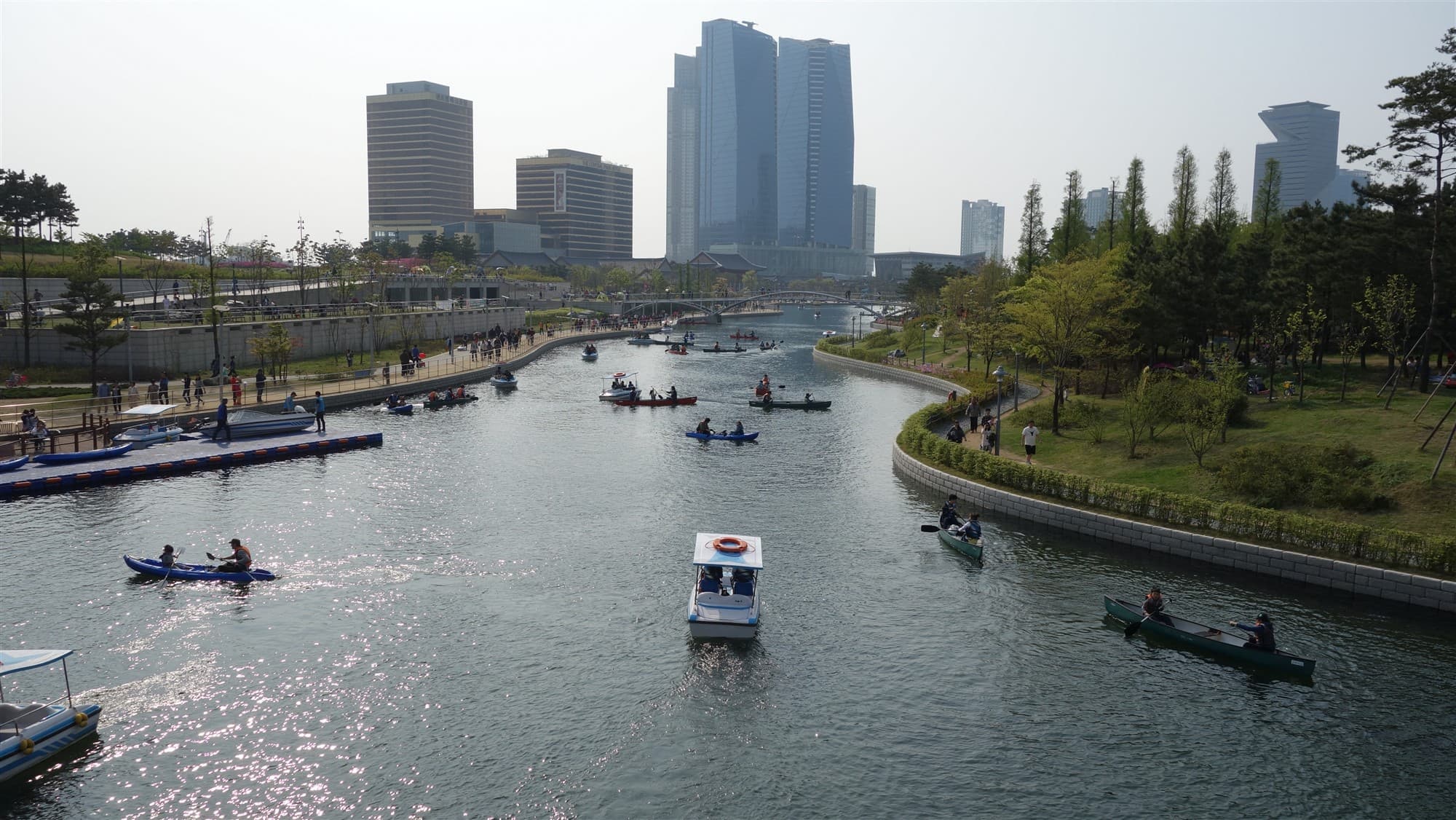
Songdo Central Park
The museum stands inside it. Free, no closing time, and 1.8 km of seawater canal to walk off an afternoon indoors.
Incheon Urban History Museum
300 m south-west. Free, opens an hour earlier, and closes on a different set of days.
Frequently asked questions
Is the National Museum of World Writing Systems free?
Yes. Admission is free apart from charged special exhibitions. Parking is not free — 600 won for the first 30 minutes, up to 6,000 a day.
What are the opening hours?
10:00 to 18:00, Tuesday to Sunday, with last admission at 17:30. The car park runs 09:30 to 19:00.
Is it open on Mondays?
No, except when the Monday is a public holiday. In that case it opens on the Monday and closes on the next weekday instead. It also closes on 1 January and on Seollal and Chuseok themselves.
Does it really have a Gutenberg Bible?
The permanent gallery displays a leaf of the 42-line Gutenberg Bible, Germany, c. 1454, in Part 2 alongside the printing and translation section.
How do I get there without a car?
Central Park station on Incheon Line 1, exit 3. The museum gives the walk as 536 m, about eight minutes: 40 m to the Tri-bowl, right, then the GCG bridge.
Can young children go in?
There is a dedicated children's gallery for ages 5 to 7. It must be booked online, every child must be accompanied, and a party is four including the guardian.
Is the museum accessible?
It states that it applied universal design as a standard. Some objects are displayed uncased and can be touched, tactile tables carry braille, audio and digital guidance, and the Hunmaengjeongeum section pairs braille with raised Hangeul and adds a sign-language video. Wheelchairs are lent at the level 1 desk.
How long does it take?
Around two hours for the permanent gallery. It is 2,064 m², with a further 677 m² of special exhibition space when something is on.
Nearby Attractions




Suggested Next Destinations
Related articles
Last verified:
Official sources
- Fact check: National Museum of World Writing Systems — hours, admission, closing days and visitor rules
- Fact check: National Museum of World Writing Systems — facilities and gallery areas
- Fact check: National Museum of World Writing Systems — access, parking capacity, charges and discounts
- Fact check: National Museum of World Writing Systems — permanent exhibition and displayed objects
- Fact check: National Museum of World Writing Systems — children's gallery, booking and age limits
- Fact check: National Museum of World Writing Systems — history, and the Pages building